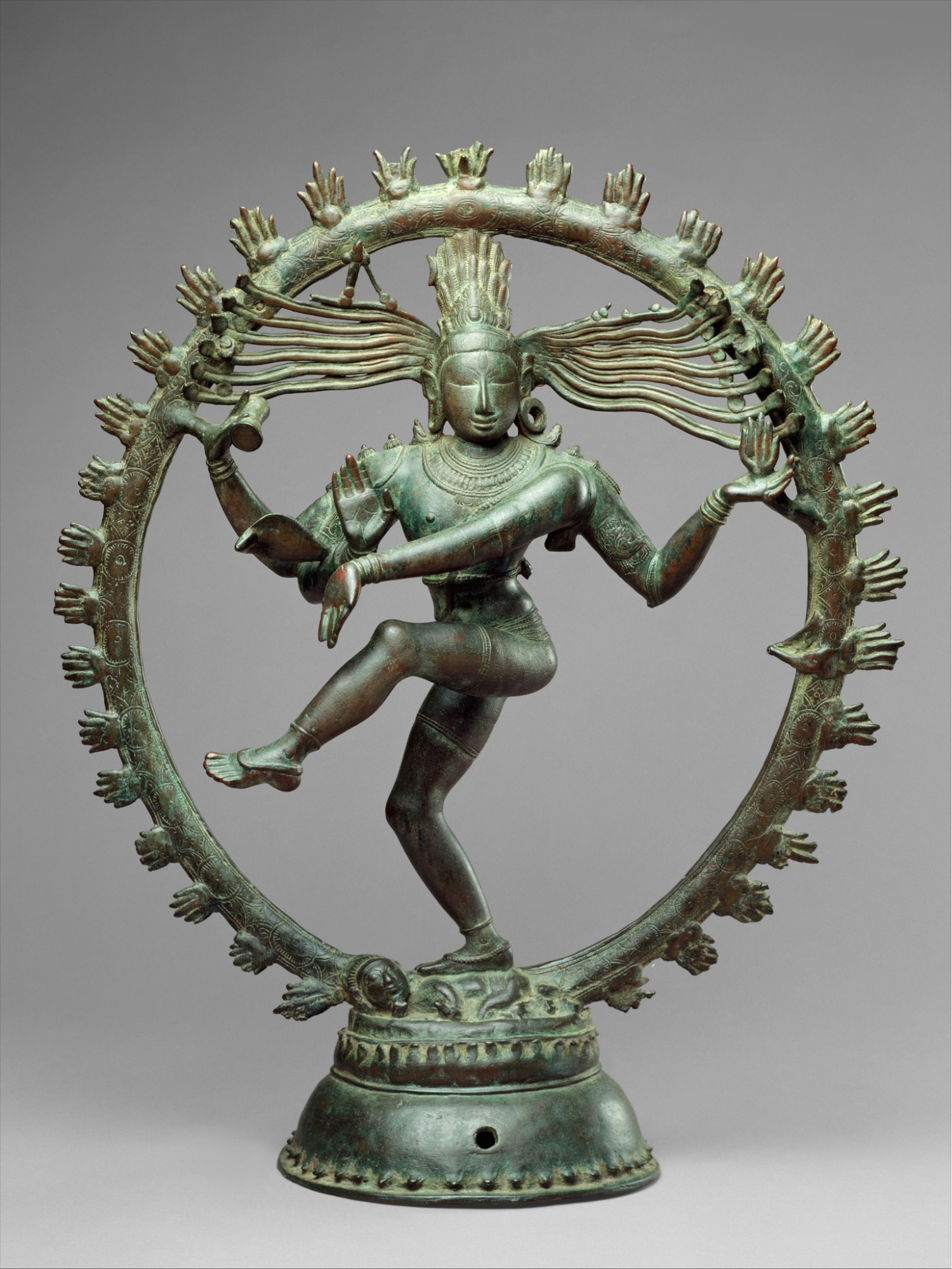
Recently the United States handed over 157 artifacts and antiquities to the Prime Minister , including a bronze statue of Nataraja .
A bas relief panel of Revanta in sandstone made in the 10th century , 56 terracotta pieces , several bronze sculptures and a diverse set of copper objects belonging to the 11th and 14th centuries were also handed over to India with this statue.
The list of items handed over includes an 18th-century sword , which mentions Guru Hargobind Singh in Persian , as well as some historical antiquities, including sculptures belonging to Hinduism , Buddhism and Jainism .
key points
Nataraja (Lord of Dance) , the Hindu god Shiva as the cosmic dancer , is found in metal or stone sculptures in many Shaivite temples , especially in South India .
It is an important part of Chola sculpture .
In the upper right hand of Nataraja is the Damru , symbolizing the sound of creation . All the compositions come out of the great sound of Damru .
In the upper left hand is the eternal fire , symbolizing destruction . Destruction is the precursor and inevitable pattern of creation .
The lower right hand is in abhaya mudra which signifies blessings and assures the devotee not to be afraid.
The lower left hand points to the raised leg and indicates the path to salvation .
Shiva is dancing on the figure of a dwarf . The dwarf symbolizes ignorance and arrogance of the individual .
Lord Shiva is depicted as the source of all kinds of movement within the universe and the doomsday is represented by dances, arches of flames , these refer to the dissolution of the universe.
The streams flowing through the tangled hair of Shiva represent the flow of the river Ganges .
Shiva has a male ornament in one ear and a female ornament in the other. It represents the fusion of male and female and is known as Ardha-Narishvara .
A snake is twisted around the arm of Shiva . The snake is a symbol of Kundalini Shakti , which resides in a dormant state in the human spine. If Kundalini Shakti is awakened , one can attain true consciousness .
Nataraja is surrounded by a cloud/nimbus of twinkling lights which symbolizes the vast endless cycle of time.
ग्लोबल वॉर्मिंग से तात्त्पर्य पृथ्वी के वायुमंडल के औसत तापमान में निरंतर वृद्धि है | मानव गतिविधि इस परिवर्तन में गर्मी-ट्रैपिंग ग्रीनहाउस गैसों के निर्माण के माध्यम से योगदान करती हे | यह वृद्धि जलवायु परिवर्तन का कारण बनने के लिए पर्याप्त हो सकती है, जिसमे समुद्र का स्तर बढ़ना, वर्षा के पैटर्न में बदलाव और पानी की आपूर्ति और फसल की पैदावार में बदलाव शामिल है |
IPCC ने हाल ही में निष्कर्ष निकला है की ग्रीनहाउस गैसो की बढ़ी हुई सांद्रता पृथ्वी की सतह के तापमान में वृद्धि का कारन बन रही है और सल्फेट एयरोसोल की बढ़ी हुई सांद्रता ने कुछ क्षेत्रोंमें सापेक्ष शीतलन का कारन बना दिया हैं | कार्बन डाइऑक्साइड और मीथेन दोनों ग्रीनहाउस गैसे हैं | 19 वी सदी के उत्तरार्ध से, हमने औसत वैश्विक तापमान में 0.6 डिग्री सेल्सियस और 0.2 डिग्री सेल्सियस के बिच वृद्धि का अनुभव किया है | वैज्ञानिक आम तौर पर इस बात से सहमत हे की पिछले 140 वर्ष में पृथ्वी की सतह लगभग 1 डिग्री फैरनहीट तक गर्म हो गई हैं |
कारण:
बिजली संयंत्रों से कार्बन डायोक्साइड
ऐरप्लाइंस
इमारतों से कार्बन डायोक्साइड
मीथेन
वनो की कटाई
प्रभाव:
मौसम पर प्रभाव
आर्थिक प्रभाव
कृषि पर प्रभाव
स्वस्थ्य पर प्रभाव
पर्यावरण और मानव जीवन पर ग्लोबल वॉर्मिंग के प्रभाव असंख्य और विविध है | बढ़ते समुद्र के स्तर, ग्लेशियर पीछे हटने और कृषि के परिवर्तन के पैटर्न को प्रत्यक्ष परिणामो के रूप में देखा जाता है |
मौसम पर प्रभाव:
बढ़ते तापमान से वर्षा में वृद्धि होने की सम्भावना हे लेकिन तुफानो पर प्रभाव कम स्पष्ट है | अत्यधिक मौसम से उत्पन्न होने वाली आपदाए जनसँख्या घनत्व में वृद्धि से बढ़ जाती हैं | चारम मौसम के काफी अधिक जोखिम का मतलब यह नहीं हे की औसत से थोड़ा ऊपर मौसम का काफी अधिक जोखिम है |
आर्थिक प्रभाव:
दुनिया भर में जलवायु परिवर्तन से होने वाले नुकसान की कुल शुद्ध आर्थिक लागत के कई अनुमान, कार्बन की सामाजिक लागत, जो भविष्य के शुद्ध लाभों और लागतो के सन्दर्भ में व्यक्त की गई हे | बैंक की रिपोेर्ट में कहा गया हे की जलवायु परिवर्तन विकास को प्रभावित क्र सकता है जिसे 1/5 तक घटाया जा सकता है | WB की रिपोर्ट बताती हे की जलवायु परिवर्तन अब तक देखि गई सबसे बड़ी और व्यापक बाजार विफलता होने का खतरा है |
कृषि पर प्रभाव:
कुछ समय के लिए यह आशा की गई थी की ग्लोबल वॉर्मिंग के सकारात्मक प्रभाव से कृषि पैदावार में वृद्धि होंगी, क्योंकि प्रकाश संश्लेषण में कार्बन डाइऑक्साइड की भूमिका, विशेष रूप से प्रकाश श्वशन को रोकने में, जो कई फसलों के महत्वपूर्ण विनाश के लिए जिम्मेदार है | ग्लोबल वॉर्मिंग कैरेबियन से समुद्री समुद्री धाराओं के माध्यम से स्थानीय प्रभाव के कारन होती है, जिसने मछली के स्टॉक को भी प्रभावित किया है | जबकि कुछ क्षेत्रों (जैसे: साइबेरिया) में स्थानीय लाभ महसूस किये जा सकते है, हाल के साक्ष्य यह है की वैश्विक पैदावार नकारात्मक रूप से प्रभावित होंगी |
स्वास्थ्य पर प्रभाव:
जलवायु परिवर्तन का सबसे प्रत्यक्ष प्रभाव स्वयं गर्म तापमान का प्रभाव होंगा | अत्यधिक उच्च तापमान कई कारणों से एक दिन में मरने वाले लोगो की संख्या में वृद्धि करता हे: दिल की समस्या वाले लोग कमजोर होते है क्योंकि गर्म मौसम, गर्मी की थकावट और कुछ श्वसन समस्याओ के दौरान शरीर को ठंडा रखने के लिए ह्र्दय प्रणाली को अधिक महेनत करनी पड़ती हैं | ग्लोबल वॉर्मिंग का मतलब अधिक ह्र्दय रोग हो सकता है; डॉक्टरोंने चेतावनी दी हे की उच्च हवा का तापमान भी जमीनी स्तर पर ओज़ोन की एकाग्रता को बढ़ाता है |
जलवायु वैज्ञानिको के बिच व्यापक समझौते कि तापमान में वृद्धि जारी रहेगी, ने राष्ट्रों, राज्यों, निगमों और व्यक्तिओ को ग्लोबल वॉर्मिंग को कम करने या इसे समायोजित करने के लिए कार्यवाई करने के लिए प्रेरित किया है |
Watching the night sky, the stars and other astronomical objects is an absolute delight. Who can forget the synchronised movement of fireflies on a dark night?
While one may still observe these phenomena in rural areas, they are becoming increasingly rare in densely populated urban areas. The presence of artificial light in the environment is a major reason behind this. Other than restricting our ability to observe the wonders of nature, the presence of excessive light has grave impact on living beings.
Light pollution
Light pollution is an unwanted consequence of outdoor lighting and usually occurs due to excessive and inappropriate artificial light. There are five overlapping components of light pollution: Urban sky glow, light trespass, glare, uplight and clutter.
Urban sky glow refers to the brightening of the night sky over urban inhabited areas. The falling of light in an area where it is not intended or needed is called light trespass. Glare is the excessive brightness of light, causing visual discomfort and disability. An uplight is directed toward the open sky, causing a very strong, localised form of light pollution. Clutter refers to an excessive grouping of lights, commonly found in over-lit areas.
Poor placement of signage and streetlights, excessive and inappropriate use of light, high population density and a higher road density and traffic density contribute significantly to light pollution. At times, certain environmental conditions such as smog, fog and high levels of suspended particles also increase the intensity of light pollution.
Impact of light pollution on plants, animals and human beings
Light pollution interferes with living organisms’ biological activities, rather the timing of it. Living beings depend on the Earth’s daily cycle of light and dark that governs behaviours such as reproduction, sleep and migration. Artificial light at night has negative effects on these behaviours.
Plants are affected by three characteristics of light: Quantity, quality and duration. Quantity of light refers to the total concentration or intensity of the light.
Light quality indicates the wavelength of the light and duration refers to the total period for which light is present. Light pollution has the potential to alter one or more of these characteristics.
Broadly speaking, light pollution affects plants by interfering with photoperiodism. Based on their sensitivity to light, plants are classified as long-day plants, short-day plants and day-neutral plants. The presence of artificial light, beyond natural light hours, can disturb the photoperiods of these plants.
Several biological activities in plants, such as pigment formation, leave shedding and the onset and breaking of bud dormancy are determined by the photoperiod. The presence of artificial night lighting alters the natural photoperiod and, therefore, upsets the plant’s development.
Many plant species (such as night-blooming cacti, for example, Queen of the Night Epiphyllum Oxypetalum) bloom only at night and depend on nocturnal pollinators for pollination. Increasing lighting can prevent flowering and pollination in such plants and hamper reproduction.
Similarly, animals are also affected by light pollution. Crepuscular (active only at dusk and dawn) and nocturnal (active only during the night) animals depend on the duration of day (light) length to start / stop their daily activities.
Exposure to artificial light interferes with these activities, decreases their chances of finding food and mates and exposes them to predators. While light pollution can potentially affect any organism, its effects are particularly pronounced on insects, amphibians, sea turtles and migratory birds.
Artificial light at night is one of the prominent causes of global decline of insects. Amphibians are sensitive to ambient light and can detect light intensity at far below human limits. Amphibians perform their mating calls at night.
Long exposure to artificial light can interfere with this process and affect their reproductive success.
Sea turtles lay their eggs on beaches. When the eggs hatch, the hatchlings find their way to the sea by detecting the bright horizon over the ocean. However, artificial lights on the coasts draw them away from the ocean and in the wrong direction.
This process exposes them to several dangers. Nocturnal birds use moonlight and starlight for navigation and hunting and thus, become disoriented by a large amount of artificial light. The collision of birds with brightly lit high-rise buildings, lighthouses, wind turbines and sea-based drilling platforms results in the death of numerous birds and is a common phenomenon in many cities.
Artificial light causes major sleep disturbances in humans. The circadian clock, which is a 24-hour day / night cycle, affects physiologic processes in practically all organisms. Brain wave patterns, hormone generation, cell regulation and other biologic functions are examples of these processes.
In human beings, disruption of circadian clock has been associated with a variety of medical issues, including depression, sleeplessness, cardiovascular disease and cancer.
Mitigation measures
We should use light only in places and at times it is needed. Installation of time and motion sensor-based lighting can help achieve this. Whenever possible, efficient lighting should be used and should be directed at the ground, not the sky.
A good lighting design should optimise the visibility of the intended object and minimise glare and light trespass. Artificial light should be minimised in ecologically sensitive areas such as routes for migratory birds and beaches with active hatching of turtle eggs.
Proper guidelines should be introduced regarding lighting on the highways and roads in or near forest regions. Awareness about this lesser-known form of pollution needs to be augmented so that we can fine-tune our activities to reduce the negative impacts and make the world a better place for all beings.
Viruses, it seems, are at war with life forms. While the world is struggling with the novel coronavirus, another one has been killing pigs, decimating the global pork and animal feed trade. African swine fever, a century-old disease that infects pigs and wild boars with a near 100 per cent fatality rate, has claimed a third of the world’s pigs since 2018. Its latest victim is India, where cases have been reported since May 2020 but have exploded in the past couple of months. Since there is no cure or vaccine, the infected animal has to be culled. With most piggeries in Asia being small-scale and the spread of the virus showing no signs of abating, what are the implications for pig farmers and the global trade of the world’s primary source of protein?
India’s northeastern states account for nearly 47 per cent of the country’s over 9 million pig population. In 2021, African swine fever cases have been reported in Meghalaya, Mizoram, Manipur, Nagaland, Arunachal Pradesh and Assam (Illustrations: Ritika Bohra)
“A BULLET TO the forehead.” In the past few months, pig farmers in Mizoram have come to dread hearing this sentence. But Thanliana and his three sons had little choice. Having lost 308 of their 500-odd pigs to a “fever” since April, they finally informed the state’s Animal Husbandry and Veterinary Department, whose officials visited their piggery in Sateek village, on the outskirts of state capital Aizawl, on June 18. They were accompanied by two armed policemen dressed in personal protective equipment or PPE.
Veterinary officer Esther Lalzoliani had already identified the pigs’ symptoms as African swine fever (ASF), a viral haemorrhagic disease that is known to infect pigs and wild boars, with a near 100 per cent fatality rate. The infected animals develop fever and their skin turns purple, with watery discharge from the eyes and severe, bloody diarrhoea before death.
With no cure or vaccine, isolation or culling are the only ways to curb the spread of this highly contagious disease which transmits through direct contact with sick animals or from anything contaminated — water, soil, feed, objects like shoes, vehicles and farm equipment, live or dead pigs or even pork products.
That day, at Thanliana’s piggery, 42 pigs were culled by the police, who used a pistol for the smaller animals and a rifle for the bigger ones. “A third of the dead are sows that were part of the breeding stock and half of the lot culled was ready to be sold to the slaughterhouse,” says Thanliana, adding that he has borrowed heavily to set up and expand the pig farm.
“Every week for the past two months, we have been burying pigs by the dozen around the farm. I called the officials to save the rest of the stock,” says PC Ramchullova, the eldest son of Thanliana. That day, too, the family dug trenches to help the team bury the animals, but had to hire an earth-mover to dig since the number of culled animals was quite high.
Lalhmingthanga, joint director of the animal husbandry department and nodal officer for monitoring the outbreak in Mizoram, who was accompanying the team, estimated the loss at Rs 10.3 lakh. “It is a rudimentary estimate,” he says, “the overall loss would be higher, accounting for person-days lost looking after the pigs, the cost of medicines and the earth-mover, among others.”
Esther and Lalhmingthanga have become used to culling-burial-loss estimation process as ASF sweeps across India’s northeastern states, which account for nearly 47 per cent of the country’s 9.06 million pig population and where pigs are a major source of livelihood and a significant part of the local diet and culture.
India does not have a history of ASF, though the disease was first described almost a century ago (more on this later). It reported its first outbreak to the World Organisation for Animal Health (OIE) in May 2020, with cases reported from Arunachal Pradesh and then Assam. A few months later, on June 24, 2020, the Centre intimated the state governments about the Department of Animal Husbandry and Dairying’s “National Action Plan for control, containment and eradication of ASF” and asked them to take “suitable action”.
Cases started to rise again this year, with Lungsen village in Mizoram’s Lunglei district reporting a pig death from an unknown disease on March 21. On April 15, the National Institute of High Security Animal Disease, Bhopal, confirmed it as the first case of ASF in the state.
By June 10, the viral disease had spread to Meghalaya, Mizoram, Manipur and Nagaland, says the Food and Agriculture Organization (FAO)’s ASF Situation in Asia and Pacific Update. In Mizoram, the government data shows ASF has caused severe losses, claiming more than 8,130 pigs in 10 of the state’s 11 districts by June 29.
With every culled pig, the meat economy takes a hit. According to the Mizoram government’s Economic Survey, the state’s annual meat production rose from 13,158 tonnes in 2011-12 to 16,533 tonnes in 2019-20, of which pork accounted for almost half.
“As of now, the spread of the disease has largely remained under control because of COVID-19 lockdown restrictions. But given the virulence of the pathogen, it won’t take long before spreading to other parts of the country. This will have a disastrous impact unless stringent biosecurity measures are implemented,” warns Swaraj Rajkhowa, principal scien tist at the Indian Council of Agricultural Research-National Research Centre on Pig, Guwahati.
Such measures include thorough disinfection, proper disposal of carcasses and waste, movement control, surveillance and early detection and humane killing of animals, as per OIE, which classifies ASF as notifiable disease.
The virulence of the disease stems from the fact that it is caused by a double-stranded DNA virus that is fairly large, genetically diverse and is talented at evading the immune system.
The Food and Agriculture Organization (FAO) says ASF virus, when in a suitable protein env ironment, can survive in a range of pH and extreme temperatures. It has been shown to remain stable in serum at room temperature for 18 months, in refrigera ted blood for 6 years and in blood at 37 degrees Celsius for a month.
It may also remain viable in faeces for 11 days, decomposed serum for 15 weeks and in bone marrow for months. As a result, only certain disinfectants are effective in its control, says FAO.
Studies also show that ASF virus, when in a feed ingredients, can tolerate long-distance sea transports. This allows it to be easily spread and transmitted.
This complex makeup, apart from a general lack of willingness to invest in research until recently, are the reasons scientists have not been able to develop a cure or vaccine against the disease, des pite knowing it for almost a century now.
Disease origin
ASF was first recognised after its introduction in domestic pigs to Kenya in 1910, according to Elsevier’s Encyclopedia of Virology. In 1921, R Eustace Montgomery, veterinary adviser to the government of Uganda, established the likely transmission of ASF from wild swine. The virus is said to have evolved around 1700 AD from a virus of soft tick that infects wild swine, including giant forest hogs, warthogs and bush pigs.
In 1957, ASF appeared for the first time outside Africa, in Portugal, and in just a few decades, spread to other countries in Africa, Europe and the Americas, even reaching the Caribbean islands of Cuba and Haiti.
It entered Asia in 2018, when China — the world’s largest producer and consumer of pork — reported the first case. That year, nations rushed to declare it a “notifiable” contagious animal disease under OIE to be managed with national and international regulations and agreements.
India, however, remained free from the disease till 2020 despite neighbours Bangladesh and Myanmar reporting ASF in 2018 and 2019. So how did the virus enter India?
Passage to India
Understanding the source and route of the spread of a virus is important to plug the gap before it can spread to pandemic-like proportions. However, scientists have so far not managed to trace its foray into the country.
Some believe that the virus has arrived via Tibet. “In 2020, [during the first outbreak] OIE reported two epicentres in Tibet, on the border of Arunachal Pradesh. People reported big carcasses flowing in rivers criss-crossing the international border,” A Chakraborty, director of research, North Eastern Regional Disease Diagnostic Laboratory, Guwahati, tells Down To Earth (DTE).
Last year, most outbreaks were on these river banks. The carcasses might have been mauled by community dogs who then brought the virus to villages, he says. In July 2020, soon after Arunachal Pradesh and Assam reported the initial outbreaks of ASF, Rajkhowa had also told DTE that the disease could have spread from Tibet.
Tapan Kumar Dutta, professor of microbiology at the Central Agricultural University College of Veterinary Scien ces and Animal Husbandry, Aizawl, says there are several potential ways the virus might have spread to India:
It first reached China (in 2018), then Myanmar and then Bhutan. There is a possibility that our domestic animals might have contracted the infection from wild boars coming from bordering countries through forests.
Praveen Mallick, commissioner, Department of Animal Husbandry and Dairying, also attributes ASF transmission to wild boars that easily cross over the border.
However, in states like Mizoram and Nagaland, that reported ASF this year for the first time, genesis of the outbreaks are shrouded in mystery.
Intra-country spread?
Lalhmingthanga suggests that the outbreak in Mizoram’s Lungsen village could have come from Bangladesh which, surprisingly, is not currently listed among FAO’s “ASF reported administrative areas since August 2018”.
He says:
The Village Council President at Rolui (just south of Lungsen) told us about pigs dying in various villages on the Bangladesh side of the border from the beginning of February. Lungsen is a village where pigs, illegally imported from Bangladesh, are kept along with the local animals. From Lungsen, the imported pigs are then supplied to Lunglei town.
There was also an outbreak in Mizoram’s Zokhawthar village, situated along the international border. It is a major hub of trade between Myanmar’s Chin State and Mizoram. Although 250 pigs died at Zokhawthar, the outbreak was quickly contained and there have been no further reports from anywhere in the vicinity.
Could it have come from Chin then? While some officials suspect this, others say the virus may have come from within India, probably Shillong in Meghalaya, because fresh as well as smoked pork from there is a staple in Aizawl. Mizoram had banned pigs from other states as soon as ASF Arunachal Pradesh and Assam reported outbreaks. But state authorities admit it is nearly impossible to check every vehicle that crosses state boundaries.
Nagaland, too, had imposed such restrictions for nearly a year to avoid any ASF outbreak by imposing restrictions on pig movements from neighbouring states since April 2020. Five months later, it allowed pigs from Punjab and Haryana, but restrictions continued for Assam and Arunachal Pradesh. Officials are now clueless about how the disease reached the districts of Phek and Kiphire.
Researchers say the incursion of ASF into the densely distributed domestic pig population of this region, mostly reared under backyard and scavenging systems with poor biosecurity measures, is also a major threat to wild boars.
A research paper in the journal Pathogens in December 2020, written by scientists working on animal diseases in India, representing various institutions, says:
Tracking down the first outbreaks of ASF in the NE [northeastern] region of India, it was observed that the outbreaks were reported alongside the river tributaries of Brahmaputra, a trans-boundary river which flows through Tibet, India, and Bangladesh. The Brahmaputra receives a number of tributaries that flows through national parks and wildlife sanctuaries of the northeast, comprising a significant number of wild boar population.”
Outbreaks can wipe out the pig population of the entire region if not appropriately controlled, they say.
The research paper has a dire warning for the future: “From the NE pocket, the disease may further spread to eastern India and then to the mainland through the river routes and interstate movement of pigs for trade and commerce. Therefore, considering the existing high density of domestic pig population in India, there is every chance that ASF might attain an endemic status if not controlled critically.”
Global spread
India’s northeastern region is the latest geography in the world to be gripped by ASF. Overall, 26 countries have reported the viral disease this year. Over two-thirds of the outbreaks have been in Europe this year. “This is the largest animal disease outbreak in history. We’ve never had anything like it,” Dirk Pfieffer, veterinary epidemiolo gist at the City University of Hong Kong, was quoted by the Associated Press.
Currently, China is the worst affected. Shenyang, a city in northern China, reported the first case on August 3, 2018. By the end of 2019, or in just 16 months, it spread to rest of the country.
The virus slipped into China from east Europe, in all likelihood through contaminated meat or pork products that were used as feed, also called swill feed. From there, it reached Vietnam, Cambodia, North Korea, Laos, Myanmar, the Philippines, South Korea, and, most recently, East Timor and southeast Asian countries.
Just like the human-impacting virus, this animal disease also demonstrates how fast it can spread in the inter-connected world. Like in the case of the COVID-19 pandemic, this disease also has global economic impacts.
As the dust begins to settle on war-torn Afghanistan, a major question is what will happen to the landmines and other ordinance littering its landscape?
More than 40 years of war have left the Afghan landscape littered with landmines as well as other munitions. These landmines have rendered fields, valleys, cities, watercourses, mountains and other terrain unusable, leading to the under-development of the country.
About 41,085 Afghan civilians have been killed or injured by landmines and undetonated munitions, according to the United Nations Mine Action Service (UNMAS).
The UNMAS is part of the United Nations Department of Peacekeeping Operations. It specialises in coordinating and implementing activities to limit the threat posed by mines, explosive remnants of war (ERW) and improvised explosive devices.
Anti-personnel mines of an improvised nature and ERW from more recent armed clashes caused 98.8 per cent of the casualties recorded in 2020 in the country, according to the UNMAS website.
More than 72 per cent of the ERW casualties in 2020 were children, the UNMAS noted.
Some 81.4 per cent of known minefields in Afghanistan have been cleared, according to UNMAS. This is about 3,300 square kilometres of land.
However, it added:
Some 3,983 identified hazards remain, threatening about 1,528 communities, impeding development by delaying the construction of new road networks, airports, transmission lines, and returnee settlement.
Afghanistan has been in the throes of instability, war and insurgency since April 1978 when the then-President, Mohammed Daoud Khan was assassinated by Afghan Communists. This led to a chain of events that ended this week when the Taliban returned to Kabul for a second time.
Several countries of the world came together in 1997 to formulate the Ottawa Treaty. It is formally known as the Convention on the Prohibition of the Use, Stockpiling, Production and Transfer of Anti-Personnel Mines and on their Destruction.
It bans the stockpiling, transfer and use of anti-personnel landmines, requires countries to clear them on their territory, while prescribing states in a position to do so to assist affected countries.
The Treaty became effective from March 199. There are a total of 164 parties to the treaty. But major countries of the world including the United States, China and the Russian Federation have not signed it. In South Asia, India and Pakistan also have not signed the treaty.
Afghanistan acceded to the Convention on September 11, 2002. The Convention entered into force for Afghanistan on March 1, 2003.
Afghanistan had undertaken “to destroy or ensure the destruction of all anti-personnel mines in these areas as soon as possible but not later than 1 March 2013” under Article 5 of the Convention.
The country asked for an extension of the deadline March 29, 2012. The request was subsequently granted and the new deadline for Afghanistan was March 1, 2023.
This was before the Taliban takeover. How will the de-mining programme fare now in Afghanistan?
“In 1999, the Taliban had declared landmines to be an un-Islamic weapon. They had issued a fatwa or edict that this was not a weapon that they should use. We are hopeful that they will stand by their previous commitment,” Khurram Parvez, a prominent anti-landmine activist based in Kashmir told Down To Earth.
He, however, noted that besides the political will of the Taliban, a lot also depended on neighbouring Pakistan. Islamabad has mined its border with Afghanistan as it, like India, believed that mines protect borders.
“Even if the Taliban agrees in the future to de-mine the area, they would require huge resources. Mining is not that expensive but de-mining is. Does Afghanistan have the resources to de-mine? What will be the nature of the international assistance? These are the questions for which we have no answers right now,” Parvez said.
Landmines impacted a person’s ability to earn. Many people who became victims of landmines were also usually caught in the crossfire in conflict zones. If they survived, they usually became victims of mental illness. Psychological support for victims of mental illnesses was usually inadequate. This was true for India, Pakistan and Afghanistan, Parvez said.
Our country gained freedom from British rule on August 15, 1947. This day holds a special place in the heart of every Indian. On this day, India's tricolour flag is hoisted at the Red Fort in Delhi. The Prime Minister addresses the nation and a military parade is held that is broadcast all over the country.
But not just India, there are several other countries that mark August 15 as a national day. Let's check out the list of countries that celebrate the national day with India.
Significance of August 15 for other countries:
1. Bahrain:
Not just India, but Bahrain also experienced British colonial rule. They announced their independence on August 15, 1971, almost more than two decades after India attained its own freedom. This day was marked by the signing of a treaty between the nation and the United Kingdom. However, Independence Day is celebrated on December 16 in Bahrain.
2. North Korea and South Korea
In North Korea and South Korea, August 15 is celebrated as the National Liberation Day of Korea. This day marked the end of World War II, and 35 years of Japanese occupation and colonial rule over Korea. In South Korea, August 15 is called ‘Gwangbokjeol’, i,e. the day the light returned, while in North Korea, it is known as ‘Chogukhaebangi nal’, i.e. Liberation of the Fatherland Day.
3. Liechtenstein
A German-speaking microstate situated in the European highlands of the Alps named Liechtenstein also marks August 15 as National Day. This day was selected as it was already a bank holiday, celebrated as the Assumption of Mary. Also, the ruling prince of that time, Prince Franz Josef II, was born on August 16. Hence, the national day was selected keeping in mind these two key events.



 India’s northeastern states account for nearly 47 per cent of the country’s over 9 million pig population. In 2021, African swine fever cases have been reported in Meghalaya, Mizoram, Manipur, Nagaland, Arunachal Pradesh and Assam (Illustrations: Ritika Bohra)


